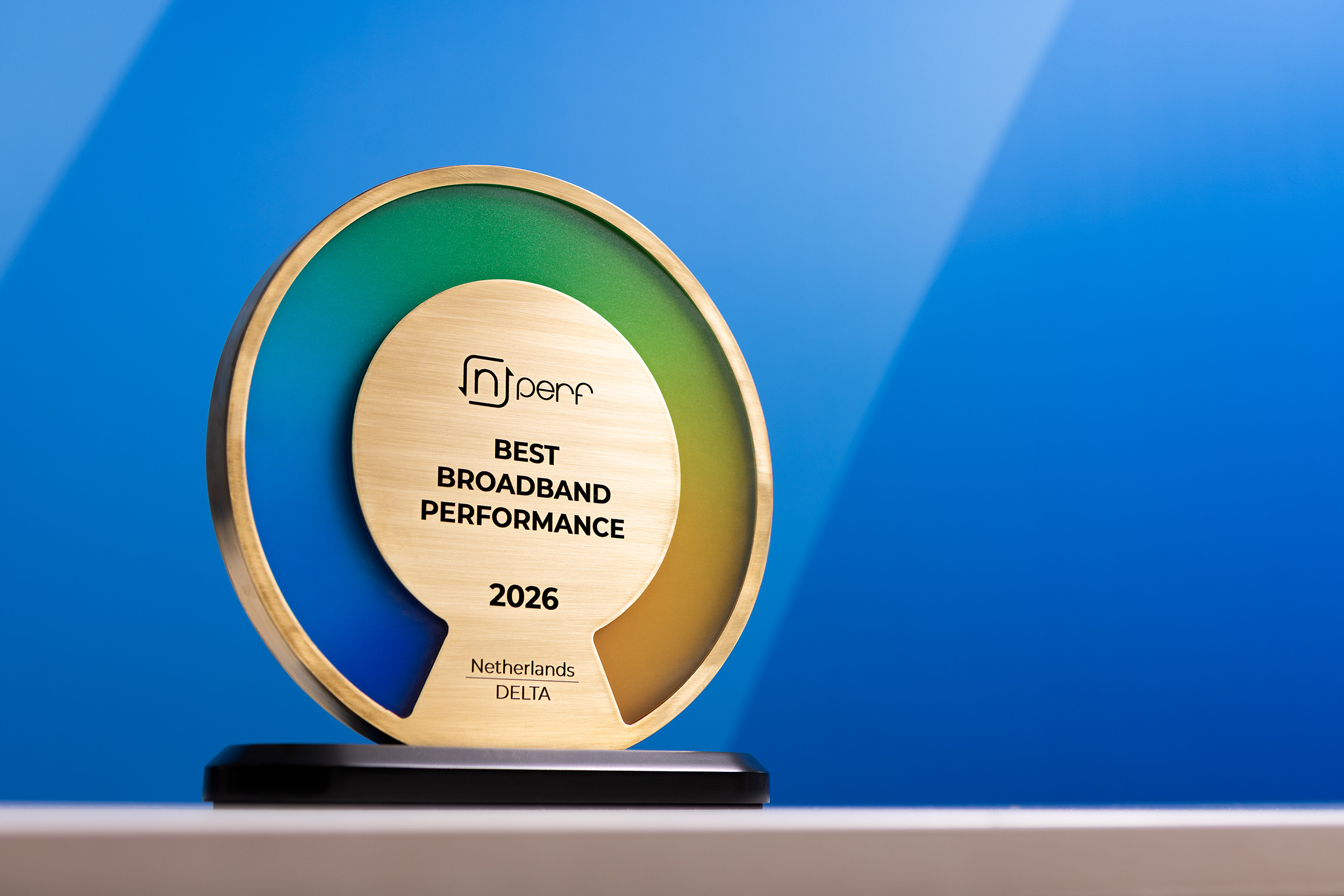
DELTA has been named the fastest internet provider in the Netherlands for the fourth year in a row. That is the finding of the annual report by nPerf, which collects millions of independent internet speed tests. DELTA scores highest on almost every key performance criterion and, with an overall nPerf score of 155,325 points, once again leaves the competition well behind. This year's biggest improvement is in Wi-Fi performance.
Streaming, video calls and gaming at ever higher quality, AI assistants and connected devices all demand very fast internet. DELTA customers benefit from the fastest internet available. nPerf measures on customers' own devices at home, which means its results include Wi-Fi.
On those devices, DELTA customers achieve an average download speed of 341.9 Mbps, an upload speed of 298.6 Mbps and a latency, or response time, of 13.6 ms. On fiber the figures are higher still, with an average of 500.7 Mbps download and 468.5 Mbps upload.
These figures therefore reflect the speed customers measure on their own devices at home, not the maximum speed of a subscription. Compared with last year, the measured download speed on fixed internet rose by more than 13 percent.
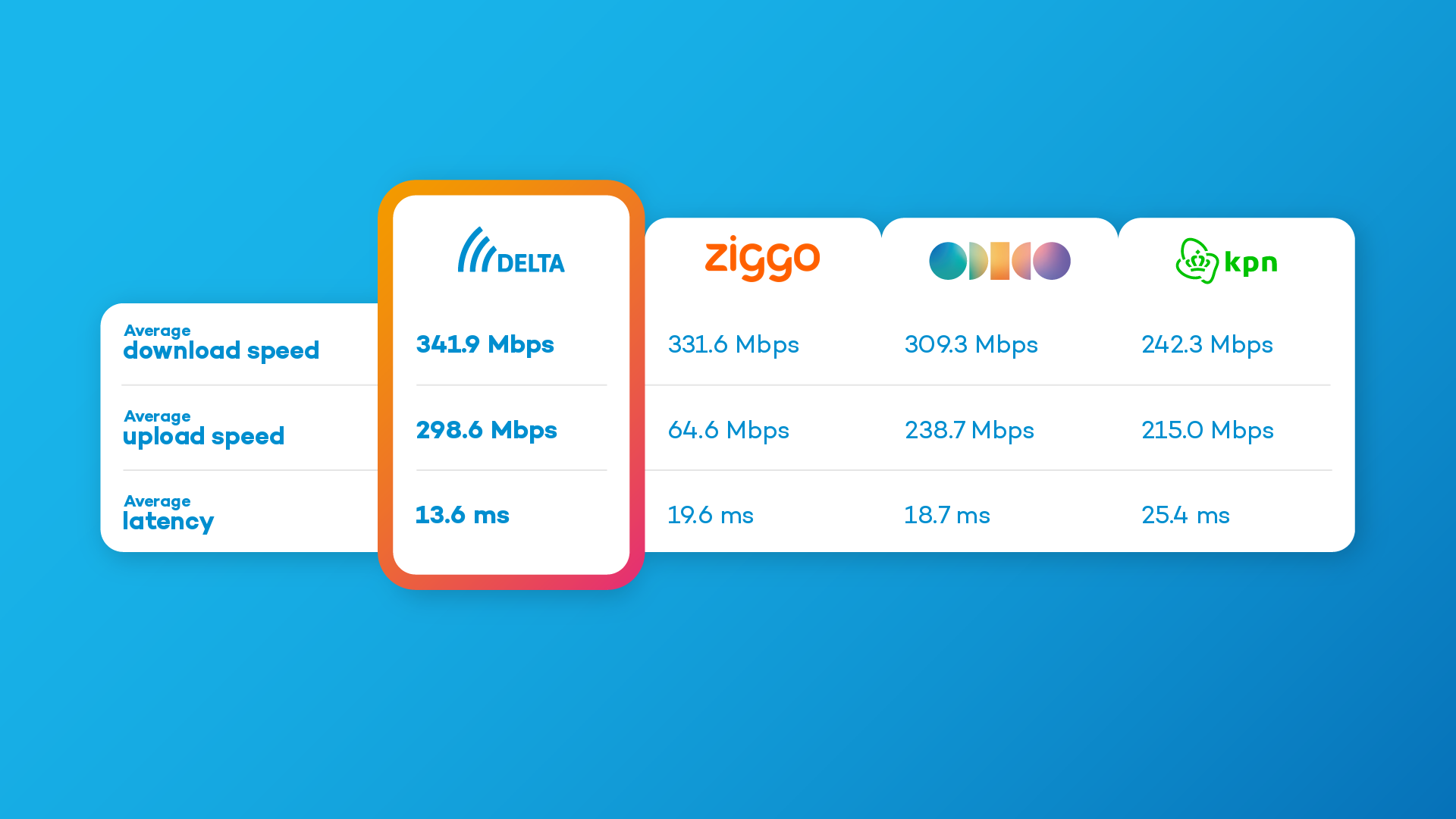
DELTA is the fastest on download speed, upload speed and latency, and this year also delivers the best streaming quality. The gap with the rest of the market is widest on upload speed. In its report, nPerf calls DELTA “a dominant force across the board” and writes that the fiber expert has consolidated its leadership position.
Noticeably faster at home
Wi-Fi is how most devices in the home connect to the internet wirelessly. The average download speed over Wi-Fi rose by almost 15 percent to 265.4 Mbps and the upload speed by more than 13 percent to 230.5 Mbps. Latency improved as well, to 15.5 ms. The lead over the number two has widened considerably: in Wi-Fi from nearly 4,900 to more than 8,100 points.
Three developments over the past year lie behind that improvement. The Wi-Fi configuration in customers' homes has been improved through remote software updates. DELTA also supplies the latest generation of Wi-Fi, Wi-Fi 7. And through customer service, the MijnDELTA app and delta.nl, DELTA shares practical tips that help customers improve the Wi-Fi in their homes.
John Wittekamp, Chief Technology Officer at DELTA: “This result is a fine recognition of the work of colleagues who improve our customers' internet experience every single day. We have not only invested in fast networks, we have also made sure that people working from home, gamers and streamers get what they need. That is why I am proud of our strong results, not only in speed but also in latency, and of the fact that we are the only provider to stay below 20 milliseconds on Wi-Fi. These measurements may be less well known than speed scores today, but we expect quality indicators like these to become increasingly important.”
The foundation for that strong Wi-Fi performance is our latest-generation fiber network. In recent years DELTA has invested heavily in the development and rollout of its fiber network, which makes the highest internet speeds possible. DELTA has the second-largest fiber network in the market. “We connect new customers every day, partly through network expansion and above all by activating households on existing networks at a rapid pace. Our fiber network is rock solid,” says Wittekamp.
What is latency?
Latency is the response time of a connection: the delay between an action and the moment something happens. The lower that number, the more immediately a video call, a game or a website responds.
About the report
The report is based on independent speed tests by consumers in the Netherlands, collected between July 1, 2025 and June 30, 2026. It uses objective measurements of download speed, upload speed, latency, web browsing and streaming quality, both during peak hours (6:00 to 11:00 p.m.) and outside them. Only providers with a test share of more than 5 percent are included in the report. nPerf reports separately on connections over Wi-Fi and on fiber connections. A measurement over Wi-Fi always runs over the fixed connection behind it as well, so those figures say something about the entire chain from the network to the device in the home.